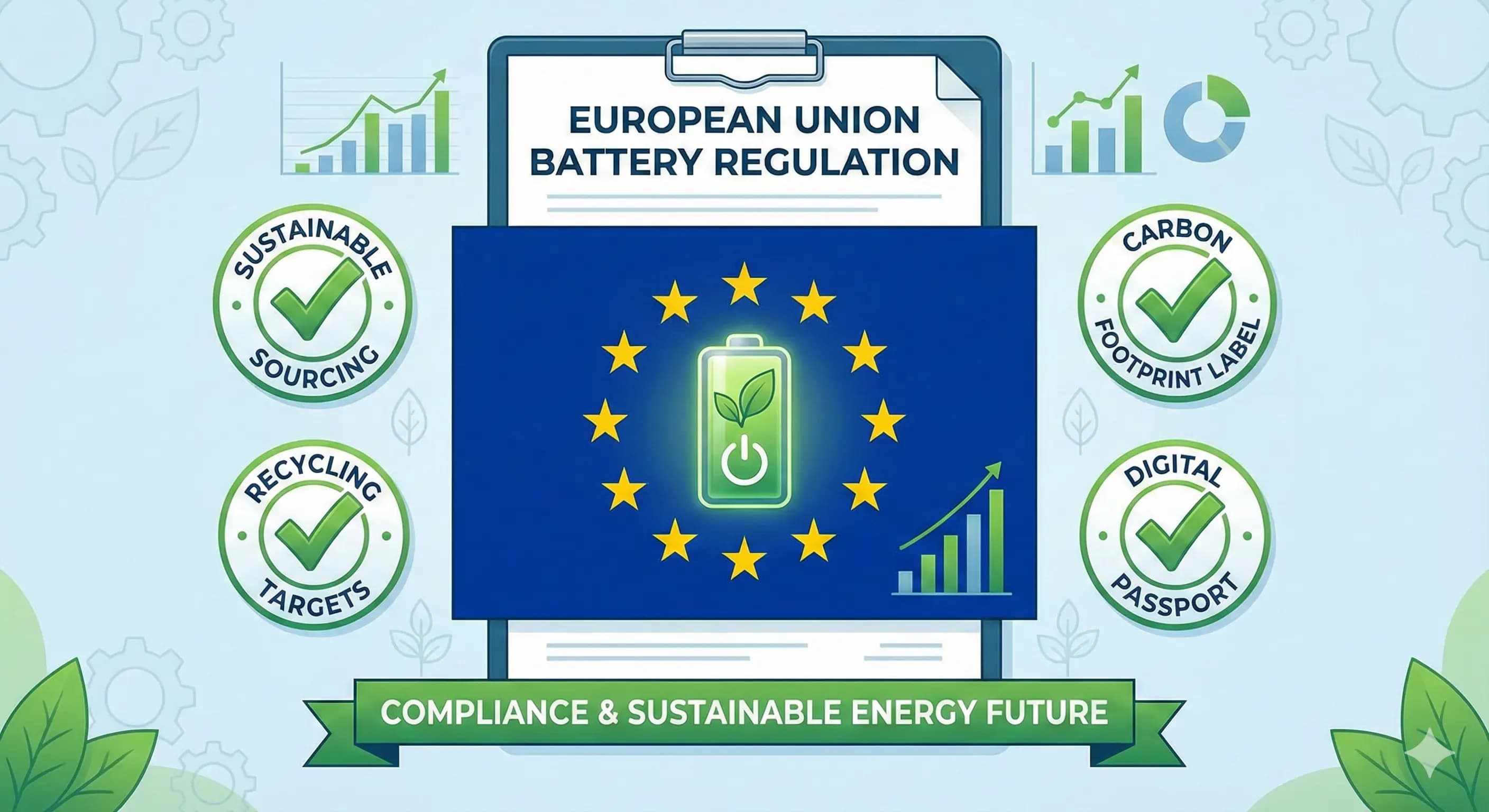
Battery Carbon Footprint
A battery's carbon footprint is the sum of greenhouse gas emissions throughout its entire lifecycle, from raw material extraction to end of life. This value is an important indicator of the battery's sustainability performance.
Life Cycle Analysis (LCA)
Carbon footprint calculation covers these stages:
- Raw Material Extraction: Mining and processing
- Material Production: Cathode, anode, electrolyte production
- Cell Manufacturing: Manufacturing of battery cells
- Pack Assembly: Battery pack and BMS integration
- Transportation: Logistics and distribution
- Use: Charge-discharge cycles
- End of Life: Recycling or disposal
EU Carbon Footprint Requirements
Carbon footprint declaration under EU Battery Regulation:
- February 2025: Carbon footprint declaration mandatory
- August 2026: Performance classification (A-E)
- 2028: Maximum carbon footprint limits
Calculation Methodology
EU-approved calculation methodology:
- Compliance with ISO 14067 standard
- kg CO2 equivalent / kWh unit
- Cradle-to-gate approach (up to factory gate)
- Use of verified data sources
- Third-party verification requirement
Emission Sources
Carbon footprint distribution of a typical EV battery:
- Raw material extraction: 20-25%
- Active material production: 30-40%
- Cell manufacturing: 25-35%
- Pack assembly: 5-10%
- Transportation: 5-10%
Reduction Strategies
To reduce carbon footprint:
- Production with renewable energy
- Use of recycled materials
- Supply chain optimization
- Energy-efficient production processes
- Low-carbon raw material sources
DigiPilPass Carbon Tracking
DigiPilPass platform automates carbon footprint calculation and reporting processes. Create EU-compliant declarations and share transparent sustainability information.
Etiketler
Karbon Ayak İziLCASürdürülebilirlikAB Regülasyonu
Category:
Regülasyonlar